Artificial intelligence has become remarkably good at reasoning. Large Language Models can write software, analyze contracts, generate research, and solve increasingly complex problems. AI agents can execute workflows and automate business processes.
Yet despite this extraordinary progress, today’s AI systems still suffer from a fundamental limitation. They don’t remember like humans do.
Most AI systems remember only fragments of previous conversations, limited context windows, or prompts saved inside a single application. Human memory, by contrast, is lifelong, associative, multimodal, and remarkably proactive.
That distinction is precisely what Gabriel Kreiman, CEO and co-founder of Engramme, believes represents the next major frontier in artificial intelligence.

Gabriel Kreiman
CEO and co-founder
Engramme
After speaking with Gabriel and reviewing Engramme’s published research, one thing became immediately clear: while much of the AI industry is building better language models, Engramme is attempting something far more ambitious, building the first generation of Large Memory Models designed to augment human cognition through lifelong memory.
The IT Brand Pulse Vision for Personal and Organizational AI Memory (POAM)
A majority of today’s leading AI systems are remarkably intelligent but remain largely stateless. That’s why the race is on to build persistent memory for models and agents.
IT Brand Pulse is looking beyond model and agent memory to Personal and Organizational AI Memory (POAM) that changes the equation by providing a persistent memory layer that spans models, agents, applications, and devices while preserving the continuity of both individual and organizational knowledge.
Rather than treating memory as a feature inside a single application, the long-term vision is a secure, continuously evolving Memory Vault of experiences, preferences, relationships, conversations, documents, and learned knowledge. For individuals, it becomes a lifelong cognitive companion that grows from birth throughout life. For organizations, it becomes an Organizational Memory Vault that preserves expertise, decisions, workflows, customer relationships, and operational knowledge across employees, AI agents, and generations of technology.

No single architecture has emerged as the definitive solution. Instead, the industry is pursuing multiple approaches. Some companies embed memory directly into AI assistants. Others build enterprise memory platforms for fleets of AI agents. Still others focus on decentralized memory vaults, blockchain-based ownership, knowledge graphs, vector memory, cognitive operating systems, or interoperability frameworks that allow memory to move seamlessly across ecosystems.
These approaches are not mutually exclusive. Each addresses a different challenge, including persistence, ownership, privacy, security, reasoning, interoperability, governance, or multimodal understanding. The eventual POAM ecosystem will likely integrate many of these technologies into a common memory infrastructure rather than relying on a single architecture.
Throughout this series, IT Brand Pulse evaluates companies by examining how closely their technologies align with this long-term vision. Every company profiled today represents an important building block toward the future of AI memory. The ultimate POAM platform will likely emerge through a combination of today’s point solutions, connected through partnerships, open standards, platform convergence, and strategic acquisitions into a unified memory layer that works across every model, agent, application, device, and organization.
The winners of the race will provide Personal and Organization Memory to 3 billion AI users by 2036 that form a market opportunity of almost $700 billion.

It is against this vision for Personal and Organizational AI Memory that we evaluate Engramme’s architecture, strategy, and long-term potential.
Engramme: A Neuroscientist Building AI
Unlike many AI founders whose backgrounds are rooted primarily in software engineering, Gabriel Kreiman approaches the problem from decades of neuroscience research.
A professor at Harvard Medical School whose laboratory studies vision, memory, and cognition, Kreiman has spent much of his career investigating how biological brains encode, organize, and retrieve memories. His published work spans human episodic memory, visual perception, continual learning, and biologically inspired artificial intelligence. That scientific foundation permeates Engramme’s philosophy.
Even the company’s name comes from the neuroscience term engram, the physical trace through which memories are encoded in the brain. During our interview, Gabriel explained that the company chose the name because it reflects its ambition to build AI systems that mirror the mechanisms of biological memory rather than simply predict the next word in a sentence.
“Remember Everything”
The company describes its mission as building AI that enables people to remember every conversation, every person, every place, every document, and every experience through searchless, promptless recall powered by novel models of human memory.
That phrase, searchless, promptless recall, may be the most important sentence on their website. It signals a shift away from today’s interaction model, where humans must continually formulate prompts, queries, and searches, toward a future where relevant memories simply appear when needed.
Memory Is Not Search
Perhaps Engramme’s most significant contribution so far is its recent position paper titled “Memory Is Not Search: Toward Proactive, Lifelong Memory in AI.”
The paper argues that today’s AI industry has largely confused retrieval with memory.
Search engines locate information. Memory retrieves meaning. Human beings rarely search their own brains. Instead, memories emerge automatically when context demands them.
Walking into a familiar restaurant instantly reminds you of previous conversations. Hearing a song recalls a vacation years earlier. Meeting an old colleague brings back projects long forgotten. That isn’t search. It is associative recall.
Engramme argues AI requires fundamentally new architectures capable of proactive retrieval from lifelong, multimodal memory stores rather than increasingly sophisticated search indexes. That distinction closely aligns with one of the central themes emerging throughout the Personal and Organizational AI Memory (POAM) market.
The next generation of AI won’t simply answer questions better. It will know what to remember before we ask.
Large Memory Models
During our interview, Gabriel introduced another concept that deserves wider attention: Large Memory Models (LMMs).
While nearly every AI company today builds Large Language Models, Engramme is developing AI models whose primary purpose is organizing, weighting, and retrieving an individual’s lifetime of experiences.
Each person receives their own private memory model. Not a shared global model. Not a corporate knowledge base. A personal model built from that individual’s digital life.
Gabriel explained that every person’s memories are unique, making individualized memory models essential. He emphasized that these models remain private because they belong to the individual rather than being shared across users.
This is a subtle but profound shift. Language models generate information. Memory models preserve identity.
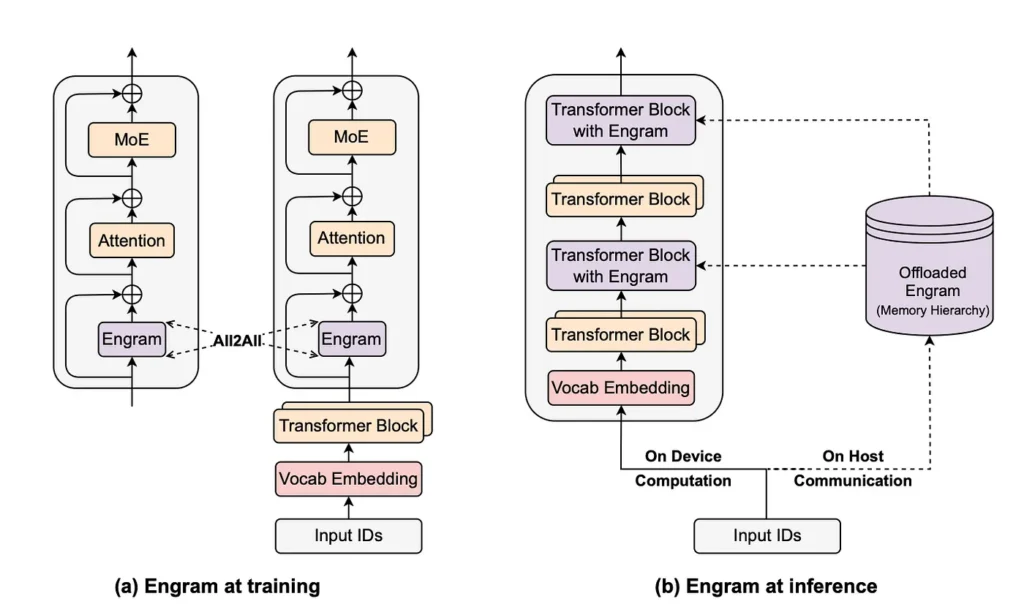
Engramme Large Memory Model
Source: Engramme: Why Large Language Models Need Memory, Not Just More Compute
The Hard Problem is Retrieving Memories
One of the most insightful moments in our discussion came when Gabriel challenged a common assumption. Most people think AI memory is about storing data. He argues humanity has already solved storage.
We have cloud storage. Phones. Video archives. Documents. Emails. Photos. Audio recordings.
The difficult problem is not recording information. The difficult problem is deciding which memories matter in a given moment and retrieving them automatically.
As Gabriel explained, storing information is relatively easy; building lifelong, proactive, associative recall is the real challenge.
That observation also appears throughout Engramme’s published research, including its study of nearly 2,000 real-world memory questions collected from participants during everyday life. Rather than asking what people search for on the internet, the researchers asked what people struggle to remember about their own lives—a fundamentally different question.
The Memorome
One topic that emerged repeatedly during our conversation was the idea of the Memor, a Latin adjective meaning “mindful,” “remembering,” or “heedful”. It is the root word for many English words related to retaining and recalling information, including the newly invented word Memorome.
Gabriel explained that creation of the word Memorome was inspired by biological terms such as genome and proteome, intended to describe the complete lifetime collection of memories accumulated from every model, every agent, every application, every device, every conversation, every document, every photograph, every video, every email, every location, and every digital interaction that belongs to an individual or an organization.
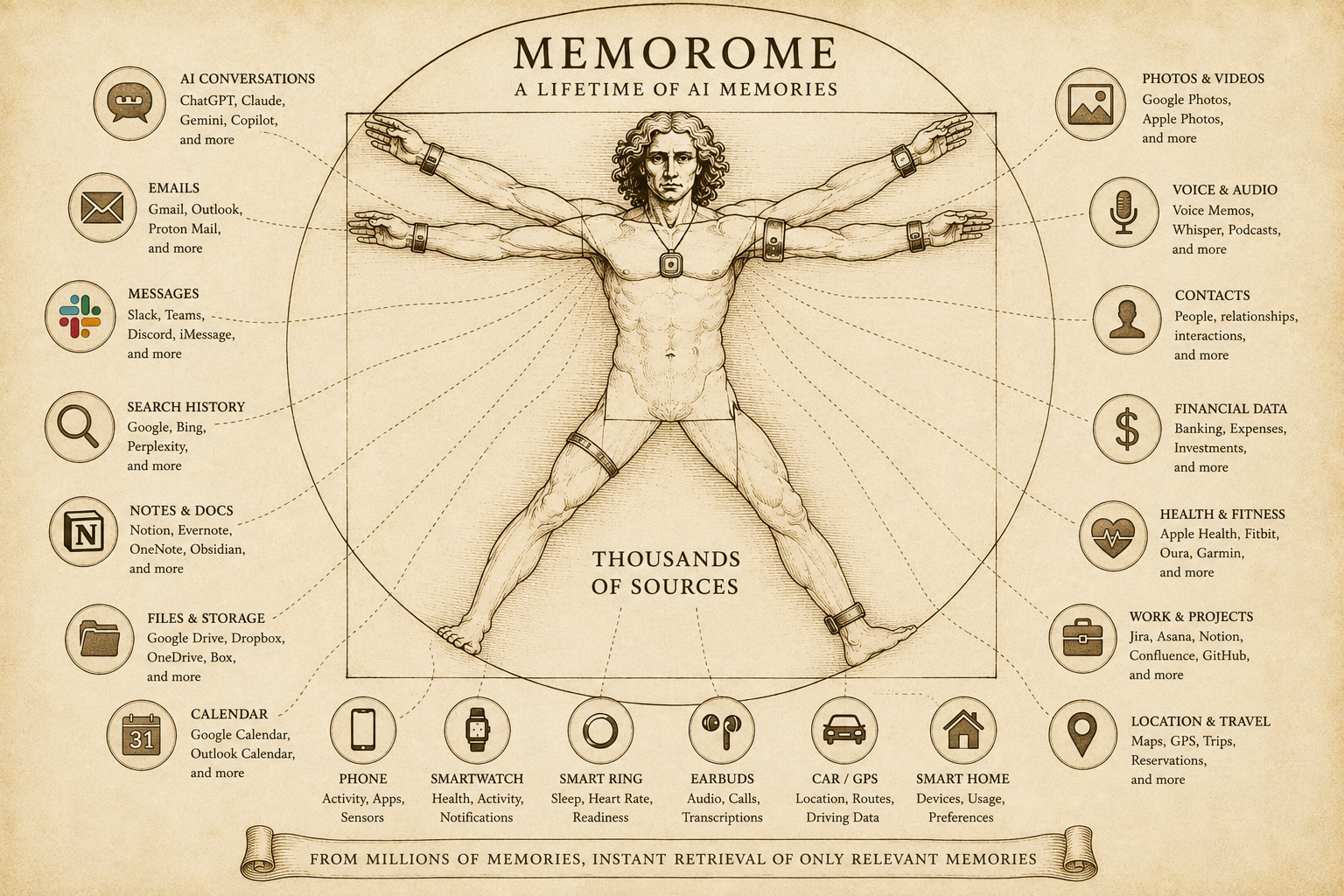
In biology, a genome is not a single gene. It is the complete collection. Likewise, a Memorome is not one memory. It is the complete memory system.
I want to acknowledge Gabriel Kreiman for introducing this foundational concept. As the Personal and Organizational Memory market emerges, this terminology provides an important framework for understanding where the industry is headed.
Personal and Organizational AI Memory
Another aspect of Engramme’s vision that stood out is its recognition that memory extends beyond individuals. Organizations need memory too.
During our interview Gabriel described architectures that separate personal memories from work memories, while also supporting shared team memories with hierarchical permissions and enterprise governance. Users can choose what belongs in their personal memory while organizations can create shared memory systems governed by security and compliance requirements.
That is why I increasingly refer to this emerging category as Personal and Organizational AI Memory (POAM).
The same underlying technology can power Individual cognitive assistants, enterprise knowledge systems, departmental memories, team collaboration, family memories, and lifetime personal archives.
Memory becomes infrastructure.
Why Engramme Matters
The AI industry often advances by making existing ideas incrementally better. Larger models. Faster inference. Longer context windows. More capable agents.
Engramme is asking a different question. Instead of making AI better at generating answers, it asks how AI can become better at remembering our lives. That may prove to be an equally important challenge.
Whether Engramme ultimately becomes the dominant platform remains to be seen. The POAM market is still in its infancy, and numerous companies, from hyperscalers to startups, are pursuing different approaches to persistent memory. But Engramme has distinguished itself by grounding its product vision in decades of neuroscience and by framing memory as its own computational discipline rather than an extension of search or language modeling.
As I’ve written throughout this POAM series, the future of AI will not be defined solely by who builds the smartest model.
It will be defined by who builds the most trusted, portable, and useful memory.
And that future will almost certainly be built not around isolated memories, but around complete Memoromes that accompany us throughout our lives, from birth through old age, across every model, every agent, every application, and every device.
The Reality vs. The Vision
Among the companies I’ve interviewed for the POAM initiative, Engramme is one of the strongest conceptual matches with the long-term IT Brand Pulse vision. Gabriel Kreiman views memory as an entirely new class of intelligence, one centered on lifelong, proactive recall instead of search. That philosophy aligns closely with our belief that AI memory will evolve into a persistent layer spanning every model, agent, application, and device.
Where Engramme differs from our broader POAM vision is primarily in scope rather than direction.
Today, Engramme is building a powerful personal memory platform centered on Large Memory Models and the concept of a private Memorome that belongs to each individual. The company is also extending that architecture into enterprise environments through team memories and hierarchical permissions, demonstrating that the same technology can support both individuals and organizations.
Engramme’s emphasis on lifelong memory retrieval, proactive recall, multimodal data, and user-specific memory models represents an important step toward that future. The broader POAM ecosystem will ultimately require additional capabilities, including standardized interoperability across AI platforms, portable memory ownership, enterprise governance, and integration with thousands of models, agents, applications, and devices.
IT Brand Pulse Takeaway
Current State
Engramme has taken one of the industry’s most scientifically grounded approaches to AI memory by applying decades of neuroscience research to the challenge of lifelong digital memory. Rather than extending Large Language Models with larger context windows, the company is pioneering Large Memory Models designed specifically for proactive, associative recall.
Emerging Trend
A recurring pattern is emerging across the POAM interviews. Companies are beginning to recognize that memory is becoming its own architectural layer rather than a feature inside an AI assistant. Engramme reinforces this trend with its central thesis that memory is fundamentally different from search, requiring new models and retrieval techniques inspired by how humans remember rather than how databases retrieve information.
Future Vision
Engramme’s work suggests that the future of AI memory will be built around individualized, lifelong memory models rather than isolated application memories. We believe over time those Personal AI Memories will connect with Organizational Memory to create the broader Personal and Organizational AI Memory (POAM) ecosystem.
Three interviews into this series, an interesting pattern continues to emerge.
- AWS is building foundational infrastructure for AI memory within multi-agent systems.
- ZetaChain is pioneering user-owned, blockchain-enabled private memory.
- EverMind is developing an integrated ecosystem spanning infrastructure, consumer memory, and self-evolving agents.
- Engramme is redefining memory itself through neuroscience-inspired Large Memory Models and proactive recall.
Viewed individually, each company is solving a different piece of the AI memory puzzle. Viewed together, they begin to outline the architecture of an entirely new computing layer.
Our long-term vision for Personal and Organizational AI Memory is unlikely to be realized by any single company. Instead, it will emerge through complementary technologies, and eventually through partnerships, platform integrations, acquisitions, and mergers, that combine today’s specialized innovations into comprehensive memory platforms serving both individuals and organizations.
About IT Brand Pulse
IT Brand Pulse is an independent research and analyst firm focused on identifying technology leadership, market transitions, and emerging industry categories. Through independent research, industry surveys, market analysis, and executive briefings, IT Brand Pulse helps technology buyers, vendors, investors, and industry participants understand the forces shaping the future of technology.
Learn more about AI Memory
June AI Memory News Reveals 8 Trends
AWS Sees Growing Interest in AI Memory, But Most Customers Are Still Focused on Individual Agents
ZetaChain’s Anuma Brings Private Memory to Consumer AI
IT Brand Pulse Releases Landmark Report Forecasting a $687 Billion Market Opportunity
Download Personal and Organizational Memory Report
Industry First: The Arrival of the Visual Memory Layer for AI
The Evolution of AI Memory: From Biology to Superhuman Systems