One of the goals of the Personal and Organizational AI Memory (POAM) initiative is to understand not only where the industry is headed, but where it is today.
Over the coming months, I will be interviewing leaders from model providers, memory infrastructure companies, personal memory platform providers, enterprise software vendors, researchers, and AI practitioners to take a pulse on the rapidly emerging AI memory ecosystem.
The objective is simple: understand how the industry’s current priorities compare to the long-term vision outlined in the IT Brand Pulse Personal AI Memory Report.
For the first installment in this series, I spoke with Venkata Sistla of Amazon Web Services (AWS), one of the co-authors of the AWS Storage Blog, “Building Persistent Memory for Multi-Agent AI Systems with Amazon S3 Vectors.”

Venkata Sistla
Sr. Worldwide Specialist SA- AI/ML
AWS
AWS occupies an interesting position in the emerging memory ecosystem. As one of the world’s largest cloud providers and a company known for its customer-driven development philosophy, AWS often has an early view into what customers are building and where demand is emerging.
The conversation revealed an important reality: while the Personal AI Memory vision may be compelling, most organizations are still in the earliest stages of their memory journey.
The Personal AI Memory Vision
The IT Brand Pulse Personal and Organizational AI Memory (POAM) vision begins with a simple observation: humans have one memory, while AI has thousands.
Today, memory is scattered across AI assistants, applications, devices, documents, enterprise systems, and online services. ChatGPT remembers information inside ChatGPT. Gmail remembers information inside Gmail. Salesforce remembers information inside Salesforce. Smart devices, wearables, and business applications each maintain their own isolated memories and context.
As a result, no single system has access to a person’s complete history, experiences, knowledge, relationships, goals, and preferences.
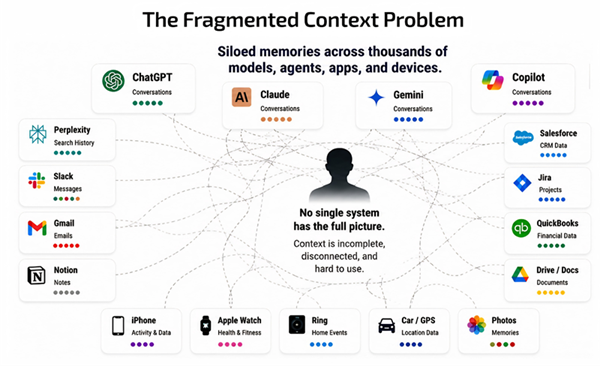
The POAM vision proposes a future where these fragmented memories are unified into a persistent Personal AI Memory system called a Memorome. Rather than maintaining thousands of disconnected memory silos, individuals would have a lifelong memory layer capable of providing relevant context to any authorized model, agent, application, or device. In the Enterprise, the Personal AI Memory of multiple team members is pooled to form Organizational Memory.
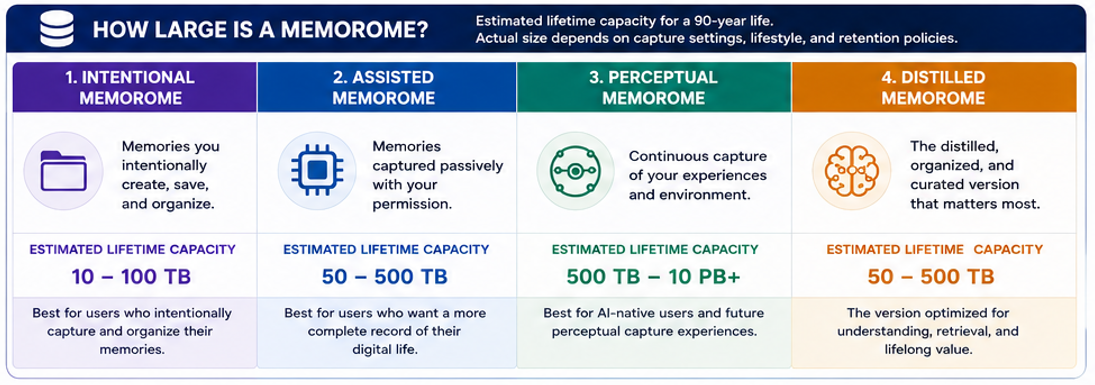
The goal is not simply to help AI systems remember more. The goal is to create human-like memory capabilities that can assemble relevant context from across a person’s digital life, enabling better decisions, planning, learning, and problem solving.
This vision serves as the backdrop for understanding where the AI memory industry stands today and where it may be headed in the future.
The Reality vs. The Vision
1. Most Customers Want Better Agents, Not Personal AI Memory
The goal is typically straightforward. Organizations want agents that can remember previous interactions, maintain continuity across sessions, and perform tasks more effectively.
What customers are generally not asking for today is a unified memory layer spanning multiple agents, applications, or domains of their business.
Most organizations are currently focused on helping individual agents remember information needed to perform specific tasks.
For example:
- A customer service agent remembers previous support tickets.
- A coding agent remembers project files and implementation decisions.
- A sales agent remembers prospects and interactions.
- A travel planning agent remembers trip details.
This approach improves the performance of individual agents, but the memory remains tied to the application or workflow.
The broader Personal AI Memory vision takes a different approach. Instead of creating memory for individual agents, it envisions a unified memory that belongs to the user and can be shared across many models, agents, applications, and devices.
From this perspective, today’s AI industry is primarily building memory for agents, while the POAM vision focuses on building memory for people.
2. RAG Continues to Dominate Customer Demand
This makes sense given where the industry currently sits.
Organizations are primarily trying to solve immediate problems such as:
- Improving answer quality
- Reducing hallucinations
- Accessing enterprise documents
- Grounding AI responses in company knowledge
These use cases naturally lead customers toward RAG architectures.
Persistent memory systems, by contrast, introduce more complex questions involving ownership, governance, privacy, memory lifecycle management, and long-term context retention.
For many organizations, those questions remain future concerns.
3. Coding Agents Lead Business Agents
AI coding assistants have become one of the most successful enterprise AI use cases, making them a natural starting point for memory-enabled agents.
Business workflow agents, however, remain relatively early.
Many organizations are still experimenting with how AI can participate in broader business processes involving sales, marketing, finance, operations, customer service, and knowledge management.
This observation aligns with broader industry trends showing that technical users continue to lead enterprise AI adoption.
AWS Is Thinking Ahead
That’s why they wrote the blog, Building Persistent Memory for Multi-Agent AI Systems with Amazon S3 Vectors
As these agent ecosystems grow, memory becomes a much larger challenge.
Multiple agents need access to shared context.
Knowledge must persist beyond the lifespan of individual workflows.
Information needs to be available across applications and interactions.
In many ways, this represents an intermediate step between today’s agent memory systems and tomorrow’s Personal AI Memory platforms.
The Memorome Vision Resonates
Perhaps the most interesting part of our discussion occurred when the conversation shifted from current customer demand to the longer-term POAM vision.
The notion that individuals accumulate a lifetime of AI memories across models, agents, applications, devices, and experiences appears both logical and inevitable as AI becomes increasingly embedded in daily life.
The Gap Between Today and Tomorrow
This may be the most important takeaway from the interview.
The Personal and Organizational AI Memory vision is largely a future-state vision.
Most organizations today are still focused on:
- RAG
- Individual agent memory
- Coding workflows
- Short-term context
The industry has not yet broadly embraced concepts such as:
- Unified Context
- Memoromes
- Personal Memory Vaults
- Memory Distillation
- Cognitive Orchestration
Yet many of the foundational technologies required to support those future capabilities are already being built.
The industry may not be asking for Personal AI Memory today, but it is steadily building many of the components that will eventually make it possible.
As AI adoption expands and organizations deploy larger networks of agents, the need for memory systems that transcend individual applications will become increasingly difficult to ignore.
The question may not be whether unified memory emerges.
The question may be how quickly the industry realizes it needs it.
POAM Pulse Takeaway
Current State: Agent memory, RAG, coding workflows.
Emerging Trend: Multi-agent memory and shared context.
Future Vision: Unified Context, Memoromes, Personal AI Memory, and Cognitive Orchestration.
The industry is still building memory for agents.
The next chapter may be building memory for people.