Defining the Video Training Data Market for AI
Artificial intelligence is entering a new phase. The first generation of AI models, large language models, was built on text scraped from the internet. But the next generation, often referred to as world models, requires something fundamentally different: a deep understanding of the physical world.
That understanding cannot be learned from text alone. It must be learned from video.
Video represents the closest digital proxy to human experience, capturing motion, causality, physics, and context across time. As a result, the AI industry is rapidly shifting toward video as a primary training input. This shift is creating a new and urgent category called “video training data infrastructure”.
However, unlike text, video data is vast and unstructured; difficult to process at scale; fragmented across millions of rights holders; and legally complex to license
This creates a critical bottleneck. AI model builders, from hyperscalers to emerging enterprise developers, need massive volumes of structured, training-ready, and legally licensable video data, but the supply chain to deliver it did not exist. Until now.
Versos AI Introduces the First End-to-End Solution
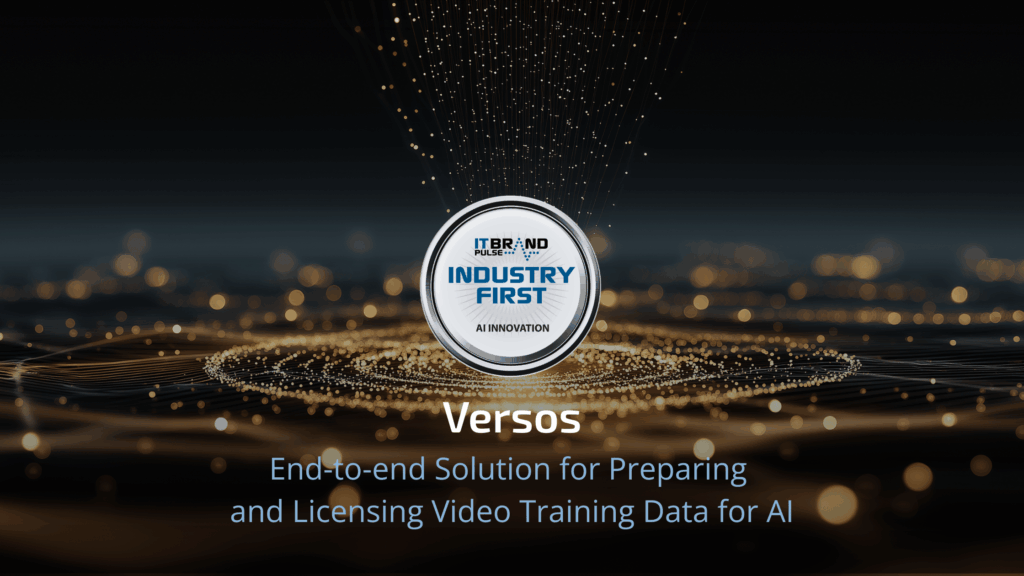
Versos AI has introduced what can be considered the industry’s first end-to-end solution for preparing and licensing video training data for AI.
Rather than acting as a broker or data reseller, Versos positions itself as infrastructure for the video training data supply chain, a system that transforms raw video assets into structured datasets and connects them to buyers in a scalable, repeatable way.
This solution addresses two fundamental challenges simultaneously: 1) preparing video data for AI training, and 2) enabling efficient licensing between fragmented supply and concentrated demand. Together, these capabilities establish a new category called “AI training data supply chain infrastructure”.
From Video Assets to Training-Ready Datasets
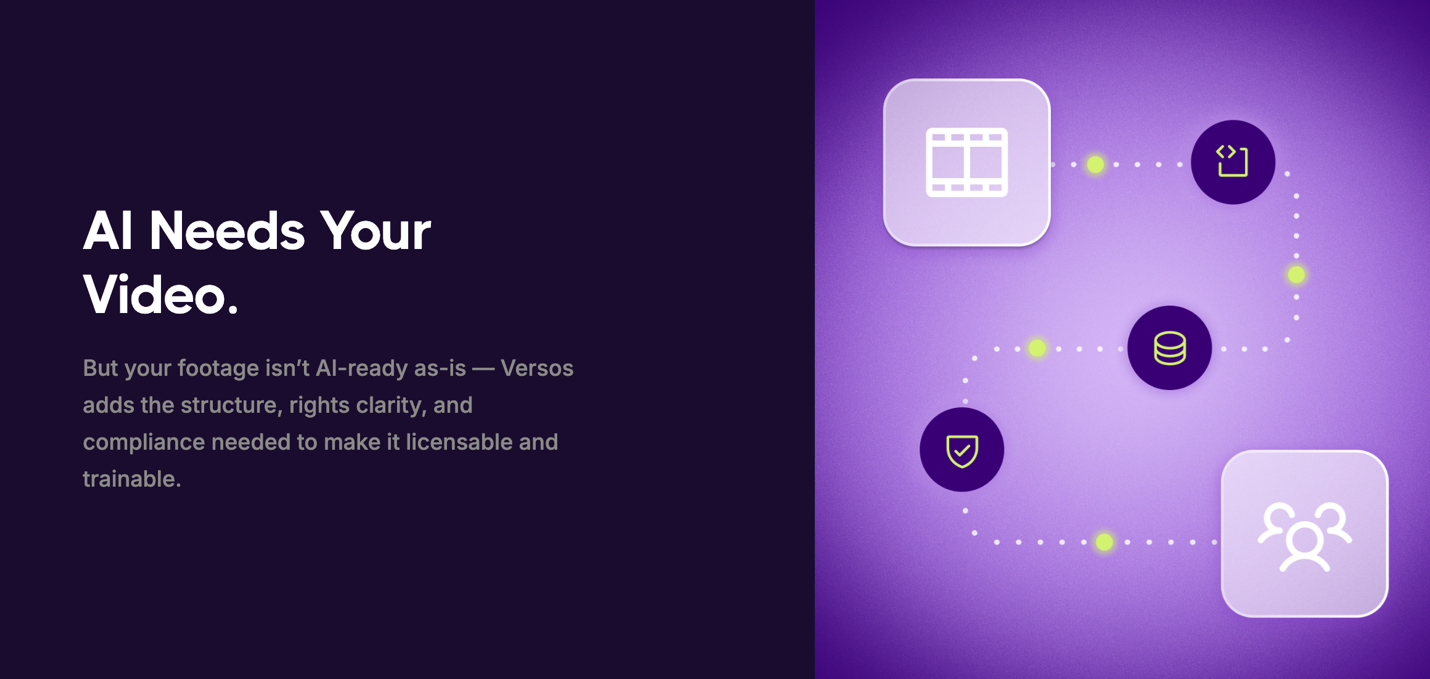
At the core of Versos’ platform is a processing pipeline that converts raw video into structured data. The distinction is critical.
A video asset, such as a film, broadcast, or recorded footage, is not inherently useful for AI training. To be usable, it must be transformed into a highly structured dataset that describes what is happening within the video at a granular level.
Versos applies AI-driven processing to segment video into scenes and events; identify objects, actions, and interactions; synchronize multimodal inputs (video, audio, metadata); generate detailed annotations across time.
In practical terms, this means a six-second clip can be transformed into a rich, multi-layered representation of reality, capturing not just what is visible, but what is happening. For example, in a sports video, the system can identify players and their movements; describe specific actions (passes, shots, outcomes); align commentary, scoreboard data, and visual context; and timestamp every interaction.
This level of detail is precisely what modern AI models require. As noted in industry discussions, model builders are increasingly demanding highly specific training data, moving from broad categories (nature documentaries) to precise scenarios (hands crushing objects, fluids flowing, specific physical interactions). Versos enables this transition by making video training-ready at scale.
Solving the Supply-Demand Imbalance
The second major innovation is how Versos addresses the structural imbalance in the video data market. On the demand side, there are relatively few buyers: hyperscalers (e.g., major AI model developers) and emerging enterprise model builders. On the supply side, there is effectively infinite fragmentation: large studios with millions of hours of content, mid-sized production companies, global archives, and eventually, billions of individual video libraries.
This creates a classic market inefficiency consisting of concentrated demand and highly fragmented supply. Versos solves this by acting as an aggregation and orchestration layer. Instead of buyers negotiating with thousands of content owners, Versos aggregates video libraries into a unified network; applies a common data structure; prepares datasets to buyer specifications; and makes them accessible on demand.
Importantly, Versos does not own or resell the data. It enables license holders to access the market directly, functioning as infrastructure rather than an intermediary. This distinction positions Versos as a platform for the entire ecosystem, rather than a participant within it.

Unlocking Previously Inaccessible Data
A key extension of this model is the ability to unlock massive volumes of archived video.
Through partnerships such as with Tape Ark, Versos is enabling access to petabyte-scale video archives stored on tape, content that was previously inaccessible for AI training. These archives represent decades of broadcast footage, cultural and historical records, as well as rare and domain-specific content.
By converting these assets into structured datasets, Versos is effectively bringing the past into the AI training pipeline, dramatically expanding the available data supply.

Enabling the Next Generation of AI Models
The implications of this industry first extend far beyond data preparation. As AI models evolve toward world understanding, they require temporal awareness (events over time), physical reasoning (cause and effect), and multimodal context (vision, sound, interaction). Video is the only data type that naturally captures all three.
Versos’ platform enables model builders to train on real-world physics (e.g., motion, transformation), human behavior and interaction, and environmental dynamics. This is particularly critical for emerging applications such as robotics, autonomous systems, industrial AI models, and simulation and digital twins.
In this context, Versos is not just supplying data, it’s enabling the foundation for the next generation of AI intelligence.
The Bottom Line
Versos AI has introduced what appears to be the first true end-to-end solution for preparing and licensing video training data for AI, a system that transforms fragmented, unstructured video into structured, licensable datasets at scale.
As the AI industry transitions from language models to world models, the importance of video data will only increase. The ability to efficiently prepare, structure, and license that data will become a foundational requirement.
In that context, Versos is not just solving a technical problem. It is establishing a new layer of the AI infrastructure stack, one that connects the world’s visual data to the models that aim to understand it. And in doing so, it may define how the physical world is translated into machine intelligence.
AI Industry Firsts Validated by IT Brand Pulse
AI Industry First spotlight the breakthroughs themselves, the moments when companies deliver genuine firsts that reset expectations, create new categories, or change how markets operate. AI Brand Leaders voted by humans and validated AI Industry Firsts together tell the full story of leadership in the AI era: who is leading and what is moving the industry forward. We invite readers to explore both perspectives to gain a complete view of how innovation and brand leadership intersect. We’re happy to cover your industry first. Just let us know.