One of the goals of the Personal and Organizational AI Memory (POAM) initiative is to understand where the AI memory market is headed and where it is today.
In recent POAM Pulse interviews, I spoke with leaders at AWS and ZetaChain, two organizations approaching AI memory from very different perspectives. AWS is building foundational memory infrastructure for developers creating multi-agent systems. ZetaChain is building a consumer application centered on user-owned private memory.
My latest conversation was with Dani Zhu, Head of Product Strategy at EverMind, whose company occupies an interesting position between those two worlds. EverMind is building memory infrastructure for developers while simultaneously developing consumer applications that reflect many of the principles behind the IT Brand Pulse POAM vision.

Dani Zhu
Head of Product Strategy
EverMind
Although the products are still early, EverMind’s strategy offers another glimpse into how the AI memory market is beginning to take shape.
The Personal AI Memory Vision
The IT Brand Pulse vision begins with a simple observation: humans have one memory, while AI has thousands. The vision ends with a prediction that billions of AI users will each possess a Personal AI Memory app with unified memory and context, forming a market worth hundreds of billions of dollars.
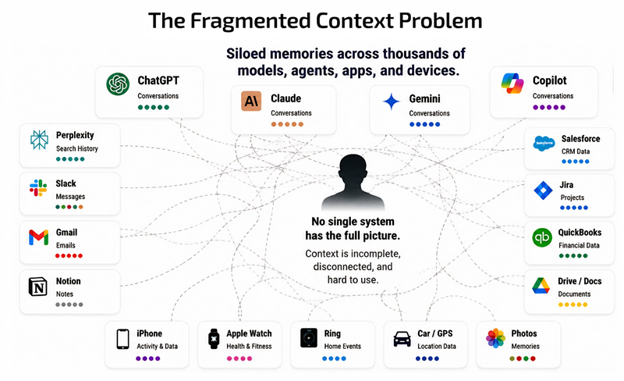
Today, memory is scattered across AI assistants, applications, devices, documents, enterprise systems, and online services. ChatGPT remembers information inside ChatGPT. Gmail remembers information inside Gmail. Salesforce remembers information inside Salesforce. Smart devices, wearables, and business applications each maintain their own isolated memories and context.
As a result, no single system has access to a person’s complete history, experiences, knowledge, relationships, goals, and preferences.
The POAM vision proposes a future where these fragmented memories are unified into a persistent Personal AI Memory Vault housing a lifetime of AI memory called a Memorome. Rather than maintaining thousands of disconnected memory silos, individuals would have their lifelong memory layer capable of providing relevant context to any authorized model, agent, application, or device. In the Enterprise, the Personal AI Memory of multiple team members is pooled to form Organizational Memory.
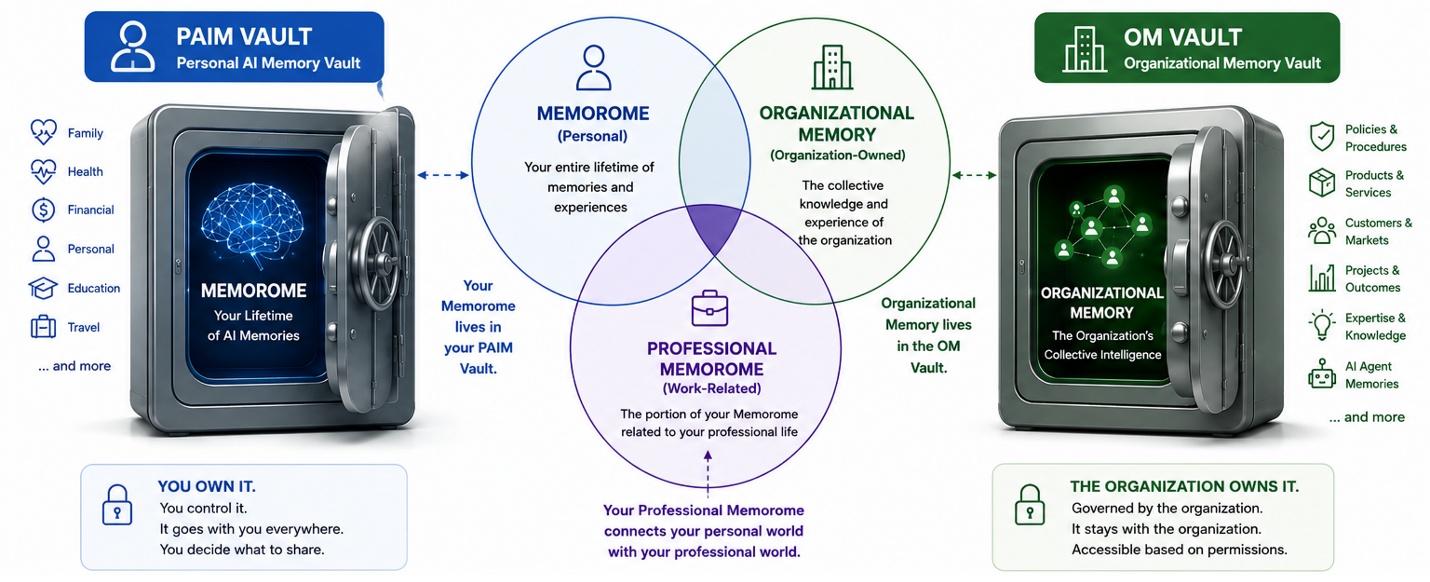
The goal is not simply to help AI systems remember more. The goal is to create human-like memory capabilities that can assemble relevant context from across a person’s digital life, enabling better decisions, planning, learning, and problem solving.
This vision serves as the backdrop for understanding where the AI memory industry stands today and where it may be headed in the future.
EverMind: Pioneering Self-Evolving Memory
The AI Bottleneck Is No Longer the Model
One of Dani Zhu’s comments captured the company’s philosophy in a single sentence:
“The bottleneck is not the model. It’s the context and the memories.”
That observation is becoming a recurring theme across the industry.
Over the past three years, AI models have advanced at a remarkable pace. Performance continues to improve, costs continue to decline, and open-source alternatives have become increasingly capable.
What has not kept pace is memory.
Today’s AI systems often forget previous conversations, lack long-term context, and struggle to accumulate experience over time. As organizations move from single-purpose assistants to autonomous agents and multi-agent workflows, persistent memory is becoming a prerequisite rather than an enhancement.
EverMind has chosen to build its company around solving that problem.
Three Products, One Memory Strategy
Unlike many AI startups focused on a single application, EverMind is building an ecosystem consisting of three complementary products.
EverOS is an open-source memory infrastructure platform for developers building AI applications. The platform supports multimodal memory, long-term retrieval, agent memory, and user memory while offering both self-hosted and managed cloud deployment. According to the company, Ever OS has attracted more than 10,000 GitHub stars and supports high-performance retrieval across multiple benchmark suites.

EverMe represents the consumer side of the strategy. Rather than allowing ChatGPT, Claude, Gemini, and other applications to maintain isolated memories, Everme attempts to consolidate a user’s digital assets into a locally controlled repository. Memories are stored in human-readable Markdown files, allowing users to review, edit, or delete information while deciding what should be shared with AI systems.
Raven is an open-source, self-evolving AI agent that learns from experience. Rather than simply storing conversations, Raven captures completed tasks as reusable cases, distills them into reusable skills, and applies those skills to future work. EverMind refers to this as “self-evolving” behavior—an approach intended to improve efficiency while reducing token consumption over time.
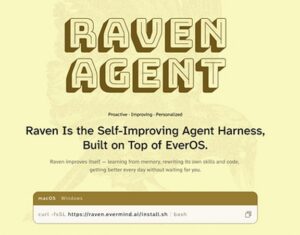
Together, these three offerings illustrate a strategy that spans infrastructure, consumer applications, and autonomous agents.
The Reality vs. The Vision
Among the companies I’ve interviewed so far, EverMind is one of the strongest conceptual matches with our vision for Personal and Organizational AI Memory (POAM).
One of the core principles of POAM is that people, not applications, should own their memories.
Dani described exactly this challenge.
Today, ChatGPT, Claude, Gemini, and countless other AI applications each accumulate fragments of information about their users. Those memories remain locked inside individual products, leaving users unable to view, organize, or move them.
EverMind’s answer is EverMe.
Rather than allowing every AI application to build its own isolated memory, EverMe seeks to create a unified, user-controlled repository that individuals own themselves. Users determine what information is retained, deleted, or shared with authorized AI applications.
This closely mirrors one of the central ideas behind the POAM initiative: Memory should belong to the individual—not the application.
Memory Is More Than Text
Another area where EverMind aligns with the IT Brand Pulse vision is its commitment to multimodal memory.
Human memories are not limited to words. They include photographs, audio, presentations, spreadsheets, videos, and countless other forms of information.
Ever OS was designed with this assumption from the beginning.
The platform treats PDFs, PowerPoint presentations, spreadsheets, audio recordings, and images as first-class memory objects. During retrieval, all content types participate equally in identifying the most relevant context.
This aligns closely with our concept of the Memorome, a lifelong collection of multimodal memories spanning text, images, audio, video, documents, and eventually the five human senses.
Wearables Become Memory Sensors
Perhaps the most forward-looking part of our discussion centered on wearable devices.
EverMind is already collaborating with companies developing AI glasses, semantic bracelets, and smart earbuds capable of continuously capturing audio, video, and contextual information.
Rather than storing everything indiscriminately, EverMind analyzes incoming streams to determine what should become part of long-term memory and how those memories should be organized.
This is significant because it moves beyond explicit user input.
Instead of asking people to save memories manually, wearable devices become passive memory sensors that continuously enrich an individual’s Memorome.
Consumer First, Enterprise Next
Unlike many AI memory companies pursuing enterprise software first, EverMind has chosen a consumer-led strategy.
EverOS provides the developer foundation.
EverMe targets everyday users.
Raven demonstrates the capabilities of memory-first autonomous agents.
Enterprise organizational memory remains under discussion, although EverMind already supports local deployment through EverOS for companies wishing to build their own solutions. Dani acknowledged that enterprises face the same problem consumers do: valuable knowledge scattered across disconnected systems.
That observation reinforces another theme emerging across the POAM interviews.
The industry increasingly recognizes two distinct markets:
- Personal AI Memory for individuals.
- Organizational AI Memory for enterprises.
Both share common infrastructure while solving different governance, privacy, and collaboration challenges.
IT Brand Pulse Takeaway
Current State
EverMind is building an integrated memory ecosystem consisting of developer infrastructure, consumer memory applications, and memory-first autonomous agents.
Emerging Trend
The company reflects a broader industry shift away from treating memory as a feature and toward treating it as foundational AI infrastructure.
Future Vision
EverMind’s strategy aligns closely with our vision of persistent, user-controlled memory that spans applications, models, devices, and eventually organizations.
Three interviews into this series, an interesting pattern is emerging.
AWS sees growing demand for memory infrastructure, although most customers remain focused on adding memory to individual agents rather than shared organizational knowledge.
ZetaChain is pioneering private, user-controlled memory with blockchain-based identity, ownership, and permissions.
EverMind is building memory infrastructure, consumer applications, multimodal memory, and self-evolving agents around the belief that memory—not models—is becoming AI’s next bottleneck.
Each company is approaching the challenge from a different direction. AWS is building infrastructure. ZetaChain is redefining ownership and access. EverMind is developing memory platforms and applications. Other companies are advancing wearable memory capture, multimodal memory, organizational memory, memory orchestration, and specialized AI memory services.
Viewed individually, these are point solutions.
Viewed together, they begin to resemble the architecture of the future.
Our long-term vision for Personal & Organizational Memory is unlikely to be delivered by a single company or a single product. It will emerge through a combination of complementary technologies, and, over time, through partnerships, platform integrations, acquisitions, and mergers that assemble today’s specialized capabilities into comprehensive Personal and Organizational AI Memory platforms.
Today’s AI memory companies are building individual pieces of the puzzle. Tomorrow’s market leaders will likely be the organizations that successfully bring those pieces together into a seamless memory ecosystem for people and organizations.
About IT Brand Pulse
IT Brand Pulse is an independent research and analyst firm focused on identifying technology leadership, market transitions, and emerging industry categories. Through independent research, industry surveys, market analysis, and executive briefings, IT Brand Pulse helps technology buyers, vendors, investors, and industry participants understand the forces shaping the future of technology.
Learn more about AI Memory
June AI Memory News Reveals 8 Trends
AWS Sees Growing Interest in AI Memory, But Most Customers Are Still Focused on Individual Agents
ZetaChain’s Anuma Brings Private Memory to Consumer AI
IT Brand Pulse Releases Landmark Report Forecasting a $687 Billion Market Opportunity
Download Personal and Organizational Memory Report
Industry First: The Arrival of the Visual Memory Layer for AI
The Evolution of AI Memory: From Biology to Superhuman Systems