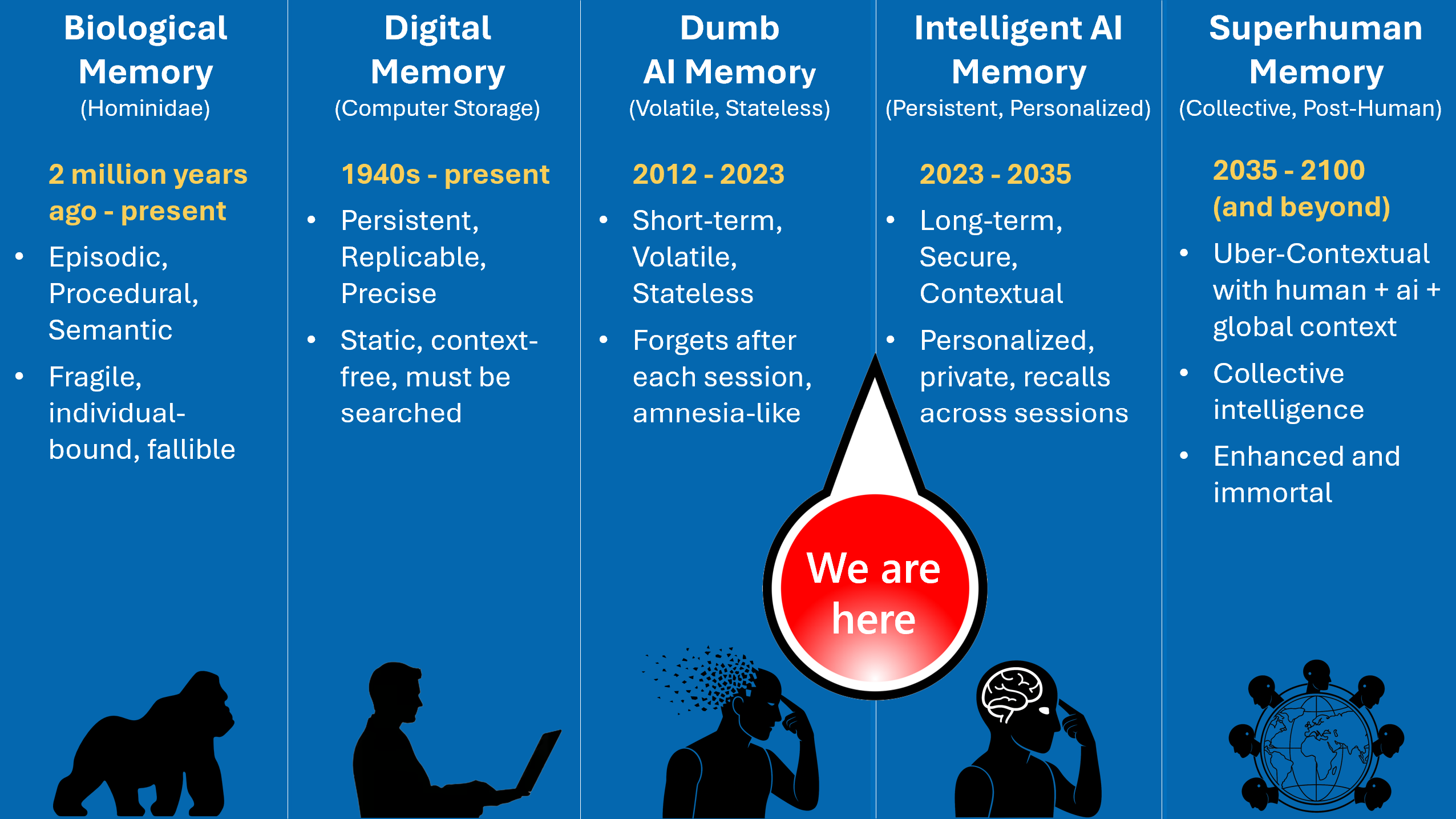
Memory is the foundation of intelligence. It defines how systems learn, adapt, and act over time. The evolution of memory, from biological origins to emerging AI-native architectures, reveals a clear trajectory: from fragile, individual cognition to persistent, scalable, and eventually collective intelligence. The attached framework captures five major phases in this evolution: Biological Memory, Digital Memory, “Dumb” AI Memory, Intelligent AI Memory, and Superhuman Memory. Each phase represents a step-change in persistence, context, and capability.
Biological Memory: The Original Intelligence Layer (2 Million Years Ago to Present)
Biological memory, rooted in the evolution of the Hominidae family, is the baseline for all intelligence systems. Humans rely on three primary forms: episodic (events), procedural (skills), and semantic (knowledge). Neuroscience estimates that the human brain contains approximately 86 billion neurons and 100–500 trillion synapses, enabling massive parallel processing.
From a storage perspective, estimates suggest the brain’s capacity ranges from 2.5 petabytes (PB) equivalent, though this is highly approximate due to its analog nature. Biological memory is dynamic and associative but also fragile, subject to decay, bias, and reconstruction errors. Studies show that human recall accuracy degrades significantly over time, with forgetting curves indicating up to 70% information loss within 24 hours without reinforcement.
Key limitation: biological memory is individual-bound and non-transferable, creating a ceiling on scalability.
Digital Memory: Persistent but Context-Free (1940s to Present)
The invention of digital storage in the 1940s introduced a new paradigm: perfect recall without understanding. From early magnetic tape systems storing kilobytes to today’s hyperscale cloud storage, digital memory has scaled exponentially.
Modern cloud providers now operate at zettabyte scale. According to IDC, global data creation is expected to reach ~175 zettabytes by 2025. Storage technologies span:
- DRAM – nanosecond latency, volatile
- SSD (NAND flash) – microsecond latency, persistent
- HDD – millisecond latency, cost-efficient bulk storage
Digital memory is persistent, replicable, and precise, with error rates as low as 1 bit per 10^15 bits using error correction. However, it is fundamentally context-free, data must be explicitly indexed and queried. There is no inherent understanding or continuity across interactions.
Key limitation: storage without intelligence creates data silos, requiring humans or software to interpret meaning.
“Dumb” AI Memory: Stateless Intelligence (2012 to 2023)
The rise of deep learning and large language models (LLMs) introduced powerful reasoning—but with a critical limitation: no memory across sessions.
Early AI systems (2012–2020), including convolutional and transformer-based models, relied on training data as static memory. With the release of transformer architectures (e.g., GPT models), context windows became the only form of “working memory.”
Typical constraints included Context window limits (GPT-3: ~2,048 tokens, GPT-4: up to 8K–32K tokens, GPT-4o-class models: up to 128K tokens); no persistence beyond session; and no personalization without external systems.
Inference is effectively stateless: once a session ends, the system “forgets.” This creates an amnesia-like experience, limiting long-term utility for agents and applications.
Key limitation: intelligence without memory prevents learning continuity and personalization.
Intelligent AI Memory: Persistent, Personalized, Contextual (2023 to 2035)
We are now entering the next phase: Intelligent AI Memory—where memory becomes a first-class system component rather than an afterthought.
This phase is defined by several converging technologies:
- Long-Term Memory Architectures – vector databases (e.g., FAISS, Pinecone, Weaviate) enable semantic retrieval at scale; Latency: ~10–100 ms per query at billion-vector scale; and storage: billions of embeddings (each 768–4096 dimensions).
- Retrieval-Augmented Generation (RAG) – combines LLM reasoning with external memory – improves factual accuracy by 20–40%+ in enterprise benchmarks and reduces hallucinations significantly.
- Memory APIs and Persistent Profiles – systems now store user interactions, preferences, and history; emerging “memory layers” create cross-session continuity; and Early enterprise deployments show 2–5x improvement in task completion efficiency.
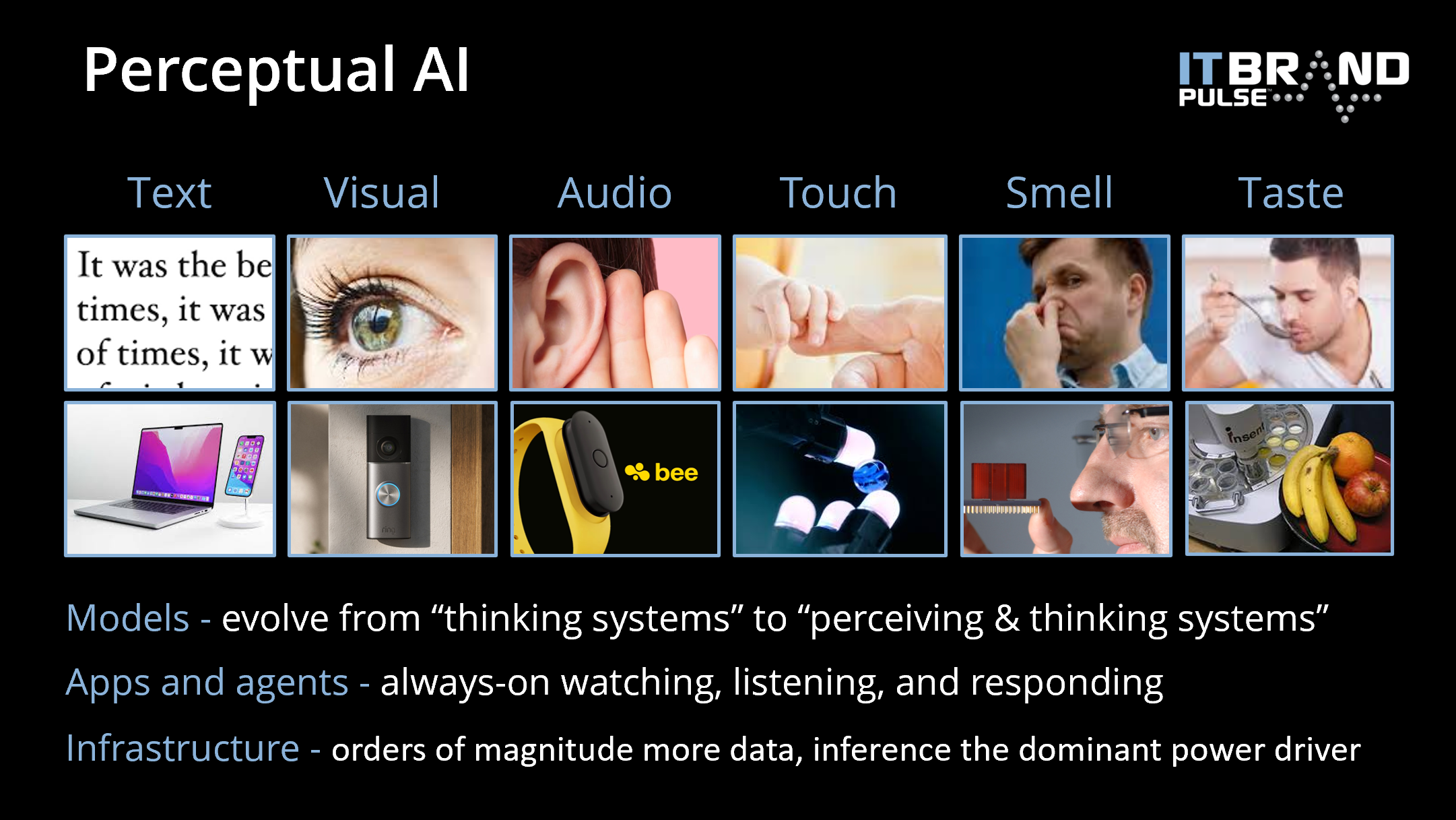
- Perceptual (Multimodal) Memory – integration of text, image, video, and audio memory expanding to include touch (haptics), smell (olfaction), and taste (gustation) as emerging sensory modalities. Embedding models increasingly unify cross-modal representations (e.g., CLIP, GPT-4o multimodal embeddings), with early-stage work extending into haptic, chemical, and sensory encoding for full-spectrum perceptual memory.
- Personal AI Memory – memory that individuals own and control outside the workplace, persisting across every AI application, model, and agent they interact with. It compounds over time into a lifelong, cross-app cognitive record (preferences, behaviors, knowledge, context.
It’s portable and interoperable across platforms via emerging Memory APIs and standards; it’s privacy-centric, user-governed, and decoupled from any single vendor or model; and it enables continuity of identity and context across sessions, devices, and ecosystems. In this phase, AI systems become stateful, secure, and deeply personalized, capable of recalling past interactions and adapting behavior over time, with memory anchored to the individual rather than the application.
Key shift: memory transforms AI from a tool into a continuous learning system.
Superhuman Memory: Collective Intelligence (2035 to 2100)
The final phase envisions Superhuman Memory, a fusion of human and machine cognition at global scale. Characteristics include
- Collective Memory Systems – shared memory across agents, organizations, and individuals; knowledge graphs at planetary scale; and real-time synchronization of global information.
- Uber-Contextual Intelligence – AI systems incorporate personal history, organizational data and global knowledge; and context windows effectively become unbounded, enabled by hierarchical retrieval systems
- Performance Projections – AI systems may operate with exabyte-scale memory access with latency targets: sub-10 ms for global retrieval via edge and distributed architectures; and integration with brain-computer interfaces (BCIs) designed to enable direct cognitive augmentation.
- Persistence and “Digital Immortality” – lifelong memory archives for individuals; and continuous learning agents that evolve over decades; preservation of expertise beyond biological lifespan.
Key shift: intelligence becomes collective, persistent, and potentially immortal.
The Next 5 Years (2026–2031): Key Predictions
- Memory Becomes the New AI Stack Layer – every enterprise AI deployment will include a dedicated memory layer (vector DB + orchestration + governance). Expect a new category called AI Memory Platforms.
- Context Expansion Beyond Token Limits – hybrid architectures (RAG, caching, memory graphs) will simulate million-token effective context, without requiring full model scaling.
- Enterprise Personalization at Scale – AI systems will maintain persistent profiles for employees, customers, and agents, driving 3–10x productivity gains in workflows.
- Standardization of Memory APIs – open standards (similar to MCP, Model Context Protocol) will emerge, enabling interoperability across models and memory systems.
- Ownership Becomes a Battleground – users understand the power of their AI memory (learning) compounding with every AI agent they use; and create demand for user owned memory stored in their personal cloud, encrypted vault, and edge/local-first systems. There will be friction with the platforms and regulatory pressure related to right to memory portability, right to delete AI memory, and audit trails for AI recall

Personal AI Memory that you own, and that grows with you across models, agents, and your lifetime.
The Remainder of the Century (2035–2100): Long-Term Outlook
- Global Memory Networks Become Core Infrastructure – just as the internet connected information, global memory layers will connect context and experience.
- AI Agents Evolve into Persistent Entities – agents will no longer be session-based tools but long-lived digital entities with evolving knowledge and goals.
- Human-AI Memory Convergence – brain-computer interfaces and wearable systems will enable humans to externalize and augment memory, blurring the boundary between biological and digital cognition.
- Multimodal “Memorome” Systems Emerge – lifetime, multi-sensory memory systems will become standard, capturing and contextualizing every interaction across modalities.
- Collective Intelligence Surpasses Individual Cognition – the combination of human and AI memory systems will create a superorganism of intelligence, capable of solving problems beyond current human comprehension.
Bottom Line
The evolution of memory is the evolution of intelligence itself. We are transitioning from stateless AI systems to persistent, personalized, and ultimately collective intelligence platforms. The next decade will define the architecture of AI memory—and those who control it will define the future of AI.