
To bring clarity and consistency to our AI Brand Leader surveys covering sales and marketing products, we needed a clear taxonomy of the modern landscape. The rapid rise of AI has blurred traditional category boundaries, making it difficult to evaluate vendor leadership using legacy frameworks. This article introduces the Modern AI Sales & Marketing Stack, a structured model that defines how today’s go-to-market technologies fit together across the full revenue lifecycle, and provides the foundation for how we analyze and measure leadership across 23 product categories.
The foundational split between sales tools and marketing tools is rapidly dissolving under the weight of AI. What is emerging in its place is a single, unified architecture, The Modern AI Sales & Marketing Stack.
This is the system that powers the entire revenue lifecycle, from identifying buyers to engaging them, guiding them through the funnel, and ultimately converting opportunities into revenue. It’s not a collection of disconnected tools. It’s a continuous, intelligent system that blends sales and marketing into one coordinated engine.
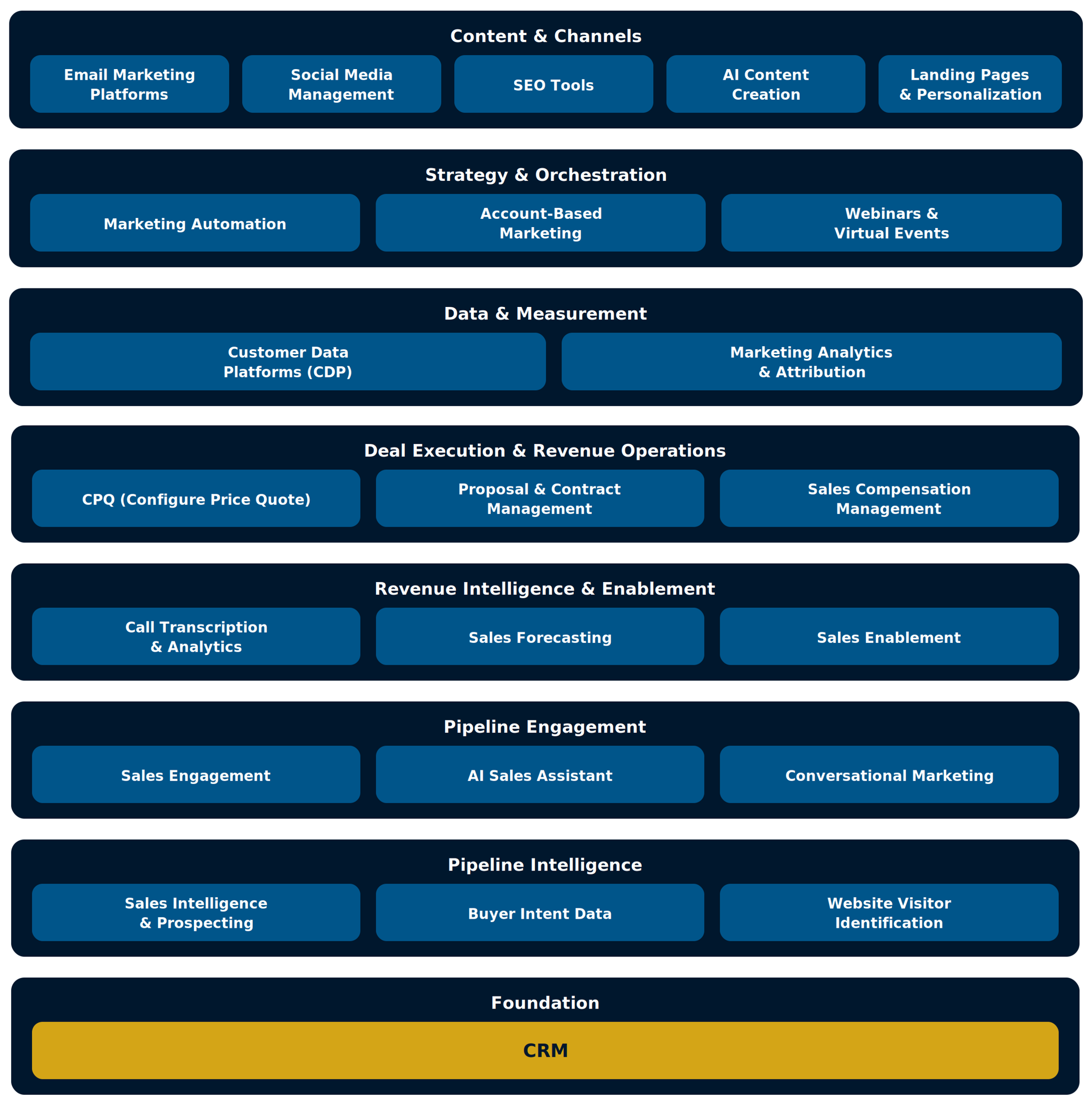
AI Sales & Marketing Stack (Source: IT Brand Pulse)
From Fragmented Tools to a Unified Stack
Historically, organizations built separate stacks. Marketing managed campaigns, content, and lead generation and sales managed pipeline, forecasting, and deal execution.
The handoff between the two was often inefficient, data was siloed, and workflows were disconnected. AI changes that structure and process completely. The AI Sales & Marketing Stack integrates both domains into a layered system. Together, these layers represent the full end-to-end AI GTM engine.
Foundation: CRM as the Anchor – At the core of the AI Sales & Marketing Stack is CRM—the system of record. It provides customer and account data, pipeline visibility and transactional history. But its role has evolved. CRM is the data foundation that everything else builds upon but no longer the center of innovation.
Pipeline Intelligence: Identifying Demand – The first active layer of the stack is Pipeline Intelligence, where both sales and marketing converge on identifying opportunities.
This includes Sales Intelligence & Prospecting, Buyer Intent Data, and Website Visitor Identification. AI enables this layer to detect in-market buyers in real time, score and prioritize accounts, and unify anonymous and known behavior. Here is where marketing signals become sales opportunities.
Pipeline Engagement: Interacting in Real Time – Next is Pipeline Engagement, where interaction happens. This layer spans both sales and marketing functions of Sales Engagement Platforms, AI Sales Assistants, and Conversational Marketing
The key shift here is that engagement is no longer manual. AI now writes and personalizes outreach; conducts conversations via chat and agents; qualifies leads automatically; and routes and nurtures prospects in real time. This is where the Revenue AI Stack becomes a system of interaction.
Revenue Intelligence & Enablement: Optimizing Outcomes – Once engagement is underway, organizations need visibility and optimization. This layer includes Call Transcription & Analytics, Sales Forecasting, and Sales Enablement.
AI transforms this layer by. analyzing conversations at scale; identifying deal risks and opportunities; recommending next-best actions; and delivering the right content at the right time. This is where performance is continuously improved—not after the fact, but during execution.
Deal Execution & Revenue Operations: Converting Revenue – At the top of the sales side is Deal Execution & Revenue Operations. This includes CPQ (Configure Price Quote), Proposal & Contract Management, and Sales Compensation Management.
AI turns these traditionally static processes into dynamic systems by generating proposals automatically; optimizing pricing strategies; streamlining approvals and workflows; and aligning incentives with outcomes. This is where pipeline becomes revenue.
Content & Channels: The Marketing Engine – This layer is where marketing drives awareness and engagement at scale. It includes Email Marketing Platforms, Social Media Management, SEO Tools, AI Content Creation, and Landing Pages & Personalization.
AI is fundamentally reshaping this layer. Content is generated, not just created. Personalization happens in real time. Campaigns adapt dynamically based on behavior. This is no longer just a top-of-funnel engine as it’s tightly integrated into every stage of the funnel.
Strategy, Orchestration & Measurement – Above everything sits the orchestration layer, where marketing and sales strategies converge. This includes Marketing Automation, Account-Based Marketing, Webinars & Virtual Events, Customer Data Platforms (CDP), and Marketing Analytics & Attribution.
This layer is becoming the control plane of the AI Sales & Marketing Stack. AI enables it to orchestrate cross-channel journeys; align sales and marketing around shared accounts; measure impact across the full lifecycle; and optimize spend and performance in real time.
Data & Measurement: The Intelligence Backbone – The Data & Measurement layer is the intelligence backbone of the AI Sales & Marketing Stack. It includes Customer Data Platforms (CDP) and Marketing Analytics & Attribution.
This layer connects customer signals, campaign activity, sales interactions, and revenue outcomes into a shared data foundation. Without it, AI systems lack the context needed to personalize experiences, prioritize accounts, measure performance, or recommend the next best action.
AI strengthens this layer by unifying customer profiles across channels; connecting anonymous and known buyer behavior; measuring campaign and pipeline contribution; improving attribution across complex buying journeys; and feeding intelligence back into sales and marketing workflows.
This is where the stack learns. Data & Measurement turns every interaction into feedback, helping teams understand what worked, what influenced revenue, and where to optimize next. In the AI Sales & Marketing Stack, this layer is not just reporting infrastructure. It is the closed-loop intelligence system that enables continuous improvement across sales and marketing.
The Collapse of the Sales–Marketing Divide
The most important takeaway from the Revenue AI Stack is there is no longer a meaningful boundary between sales and marketing. Marketing generates signals that sales acts on immediately; sales interactions feed back into marketing systems; and AI operates across both domains simultaneously. What used to be a handoff is now a continuous loop.
From Systems of Record to Systems of Action
The defining shift across the AI Sales & Marketing Stack is the move to systems of action.
In the past systems stored data and tools executed tasks. Now AI identifies opportunities, AI engages buyers, AI guides decisions, and AI executes workflows. The stack doesn’t just support revenue teams; it actively drives revenue outcomes.
The Future of the AI Sales & Marketing Stack
The winners will not be the best tools in each category. They will be platforms that unify the entire stack into a single, intelligent system. Looking ahead, the Revenue AI Stack will evolve toward:
- Autonomous AI agents managing end-to-end workflows
- Real-time personalization across every touchpoint
- Unified platforms replacing fragmented tools
- Continuous learning systems that optimize every interaction
Bottom Line
The Modern AI Sales & Marketing Stack represents a new model for go-to-market execution where CRM anchors the data; intelligence identifies opportunities; engagement connects with buyers; optimization improves outcomes; execution converts revenue; and marketing fuels and orchestrates the entire system. AI connects it all.
Sales and marketing are no longer separate functions, they’re components of a single, intelligent revenue engine.